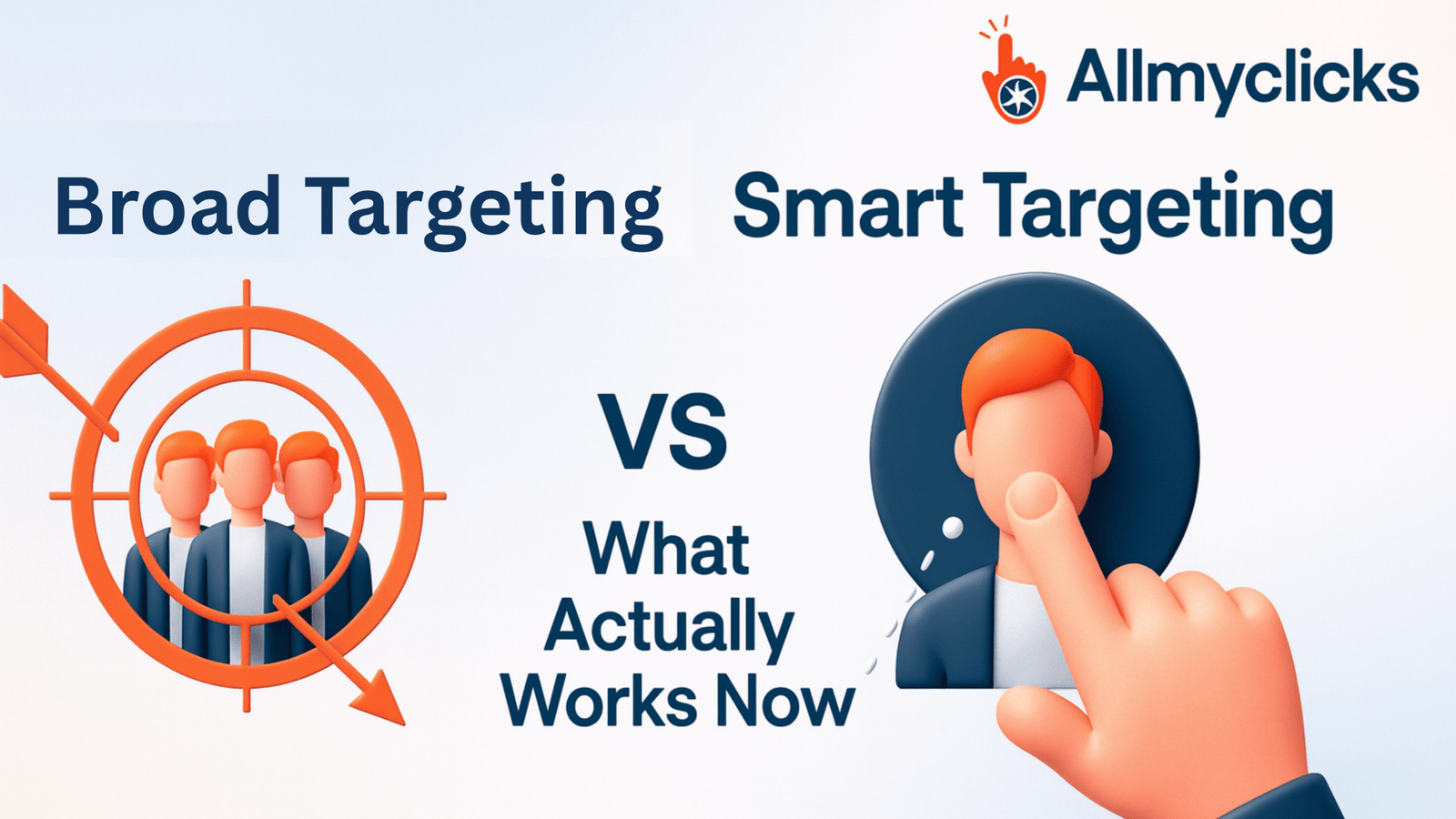
Digital advertising has changed a lot in the last few years.
Earlier, targeting was everything.
Interests, behaviors, job titles, and demographics were heavily used.
However, today things look very different.
Platforms like Meta and Google now rely more on AI.
They use machine learning to find the right users.
Because of this, a big question comes up.
Does broad targeting work better now? Or is smart targeting still the winner?
Let’s break it down in a simple way.
What Is Broad Targeting?
Broad targeting means you give very few restrictions to the platform.
You do not select interests.
You do not narrow the audience much.
Instead, you allow the algorithm to decide.
For example:
- Age range: 21–55
- Location: India or a city
- Gender: All
- No interests selected
That’s it.
The idea is simple.
If your creative is strong and your tracking is clean, the system learns fast.
Why Broad Targeting Works Better Now
First, platforms have more data than ever.
Meta and Google track behavior across apps, websites, and devices.
Second, privacy updates changed everything.
Interest data is less reliable now.
User signals are limited.
Because of this, AI-based delivery performs better.
Also, broad targeting helps in faster learning.
The algorithm gets more room to test.
So results often stabilize quicker.
This is why many advertisers now see lower CPMs and better scaling with broad setups.
What Is Smart Targeting?
Smart targeting is not old-school interest stuffing.
It is more refined.
It includes:
- Custom audiences
- Lookalike audiences
- Retargeting
- High-intent signals
For example:
- Website visitors
- Video viewers
- Lead form openers
- Past purchasers
Here, data quality matters more than size.
Where Smart Targeting Still Wins
Smart targeting shines in the middle and bottom of the funnel.
For example:
- Retargeting abandoned users
- Upselling to past buyers
- Closing warm leads
These users already know your brand.
So messaging converts better.
Also, smart targeting helps control cost.
You avoid wasting budget on cold users when intent is high.
Therefore, it still plays a big role.
Broad vs Smart: What Actually Works Now?
The truth is simple.
It is not broad OR smart. It is broad AND smart.
Here is what works best today:
Top of Funnel (TOF)
Use broad targeting.
Let the algorithm explore.
Focus on strong hooks and creatives.
Middle of Funnel (MOF)
Use engagement-based smart audiences.
Video viewers.
Profile engagers.
Landing page visitors.
Bottom of Funnel (BOF)
Use high-intent smart targeting.
Cart viewers.
Leads.
Past customers.
This hybrid approach wins consistently.
The Role of Creatives (Most Important)
Targeting alone does not work anymore.
Creatives do the targeting now.
Your ad copy, visuals, and messaging decide who clicks.
For example:
- Salary-focused creatives attract job seekers
- Luxury visuals attract premium buyers
- Problem-based hooks filter serious users
So even with broad targeting, the right audience self-selects.
This is why creative testing matters more than interest testing today.
Tracking and Optimization Matter More
Without proper tracking, both methods fail.
You must have:
- GA4 events
- Meta pixel with correct signals
- Conversion API where possible
When data flows cleanly, AI learns faster.
That is when broad targeting really shines.
Final Verdict
Broad targeting is powerful now.
But it is not magic.
Smart targeting still matters.
Especially for retargeting and scaling profitably.
The real winners use both.
They rely on strong creatives.
They trust data, not assumptions.
If you want long-term results, focus on systems, not shortcuts.
For more performance marketing strategies and real-world ad frameworks, visit Allmyclicks.com.